Navigating the Gap: Accessibility in Qatar’s Education City, One Door at a Time
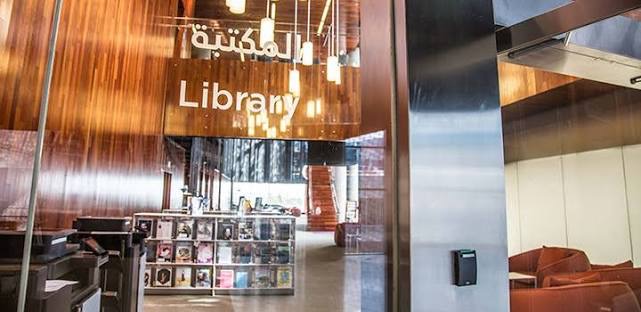
During her freshman year at Northwestern University in Qatar, Maryam Hamad Al-Gurraheem often rolled her wheelchair up to the library entrance and waited for someone to open the heavy door.
Before the academic year ended, the 19-year-old student decided that she was done waiting. She contacted Michael McDonough, NU-Q’s director of health, safety, security and environment, and explained why the library needed an automatic entrance.
Facilities later installed a sensor-activated door that opens automatically when someone approaches.
“Libraries are for learning, and they must be accessible to everyone,” Al-Gurraheem said. “I shouldn’t have to do this extra work just to make sure that I’m included.”
The change represents a small victory within a much larger effort to improve accessibility across Qatar’s Education City.
Qatar introduced a new legal framework in 2024 intended to protect the rights of people with disabilities in areas including education and employment. However, for students like Al-Gurraheem, inclusion is not measured only through legislation. It is experienced through accessible entrances, supportive professors and the personal burden of repeatedly asking institutions to meet their needs.
As Qatar continues to position itself as a regional leader in disability rights, experiences across its flagship Education City campuses reveal the complicated journey from policy to everyday practice.
The 2024 framework builds on earlier efforts, including Qatar’s 2004 disability law and its 2008 ratification of the United Nations Convention on the Rights of Persons with Disabilities.
The Ministry of Education and Higher Education has also established a Department of Special Education and Inclusive Education, which offers services including specially equipped resource rooms, individual instruction and specialized institutions. These include Al-Hidaya schools for students with disabilities and autism, as well as the Audio Education Complex for students with hearing disabilities.
NU-Q’s Journey Toward Accessibility
At NU-Q, academic accommodations are coordinated through AccessibleNU-Q, known as ANU-Q. Housed within Academic Advising, the office determines and organizes accommodations for students with disabilities.
The process requires documentation from licensed professionals in Qatar outlining a student’s diagnosis, functional limitations and recommended accommodations.
ANU-Q defines reasonable accommodations as individualized and flexible measures intended to provide equal access rather than an unfair advantage. These may include assignment extensions, additional time during exams and quizzes, or relocating classes to more accessible rooms.
For Al-Gurraheem, extensions and additional time on quizzes have been particularly helpful.
“That really helps me not stress during assignments,” she said.
However, receiving formal accommodations does not always remove the responsibility placed on students to explain their needs. At the beginning of each semester, Al-Gurraheem said, she has to approach her professors and inform them about her accommodations.
“At university, I had to physically go up to each professor and be like, ‘Hey, I have accommodations. Here are my papers to prove that,’” she said. “I don’t like that I have to prove that I have a disability because I’m not just my disability. I’m more than that.”
NU-Q’s current building has served as the university’s campus since 2017. McDonough said it was constructed according to international building codes that included some accessibility considerations, such as wider doorways and ramped access.
“It wasn’t specifically built with ADA standards in mind,” McDonough said, referring to accessibility requirements established under the Americans with Disabilities Act. “But they have what they call international building code.”
Despite these features, he acknowledged that the building still falls short of higher accessibility benchmarks, particularly because many of its doors are not automatic.
Some smaller improvements can be managed internally. For example, the university has adjusted its elevator doors so they remain open for longer.
“We have to allow people, maybe in a chair or on crutches, to get into the elevator before the doors close,” McDonough said.
Larger structural changes require cooperation between NU-Q and Qatar Foundation, which owns and manages much of Education City’s infrastructure.
McDonough said the university has identified areas that need improvement, although he believes NU-Q remains one of the more accessible buildings in Education City.
“NU-Q is probably one of the better buildings here in Education City,” he said.
A wider project to install more automatic doors has been discussed, but its implementation depends on coordination with Qatar Foundation.
“We’re still waiting for the project to move on to the next phase with Qatar Foundation,” McDonough said.
A Different Experience at Carnegie Mellon
Across Education City, accessibility can vary from one university building to another.
Rym A., a 19-year-old sophomore at Carnegie Mellon University in Qatar, has a physical disability that affects her ability to walk long distances. She described her campus as highly accessible.
“The doors open automatically, there are ramps wherever you go, and there are elevators,” she said. “Wherever there are stairs, there’s either a ramp or an elevator.”
Although Rym does not use a wheelchair, she needs to avoid excessive walking. She said the university’s design allows her to move around independently without regularly asking others for assistance.
“I can envision that if someone had a wheelchair, they could easily travel through CMU-Q without needing any help because it’s that inclusive,” she said.
Her experience highlights how infrastructure can shape a student’s independence. When automatic doors, ramps and elevators are integrated into a building’s design, students do not have to request assistance each time they enter a room or move between floors.
The contrast between the two campuses also shows that accessibility across Education City is not always consistent. Although universities share the same broader campus, students may encounter different levels of access depending on the building they enter.
A System-Wide Vision
Because Qatar Foundation owns and manages much of Education City, major structural changes often require coordination between QF and individual universities.
Qatar Foundation has stated that it aims to make Education City a model of inclusivity. In a November 2023 announcement, Mohamad Al Khalifa, director of capital projects at Qatar Foundation, said new initiatives were guided by the principles of universal design and inclusivity from conception to completion.
He added that QF’s accessible facilities should serve as a regional benchmark for inclusive design.
However, the pace of implementation means that students may continue to face barriers while projects move through institutional approval processes.
For Al-Gurraheem, waiting for larger changes means continuing to identify barriers and raise concerns herself.
“It’s an extra burden on me when I have to advocate for people with disabilities and prove that we’re more than our wheelchairs,” she said. “I think we’re in the 21st century, and these issues shouldn’t exist anymore.”
Al-Gurraheem manages a full academic schedule, often arriving on campus at 8:30 a.m. and staying until 3:30 p.m. to complete her work. She participates in the Qatar Culture Club and Book Club and hopes to join Studio 20Q.
Her involvement requires her to spend long hours on campus, making reliable access to classrooms, libraries and other facilities essential.
She said the responsibility of repeatedly drawing attention to accessibility barriers can feel isolating. Although NU-Q has mental health services, she primarily uses the office as a place to discuss concerns related to her experience on campus rather than for regular counseling.
“I just hope that in the future there is a better system,” she said.
A 2023 report by WISE, Qatar Foundation’s global education initiative, examined disability inclusion within Qatar’s education system. The report identified several challenges, including a stronger focus on visible disabilities, limited alternative academic pathways such as vocational training and a “silo effect” in which institutions and administrative bodies do not always coordinate effectively.
The report also raised concerns about confusion surrounding who is covered by different policies, including whether particular provisions apply only to Qatari nationals or to all residents.
Its recommendations included improving infrastructure, investing in staff training and human resources, and introducing stronger systems for monitoring and evaluation.
These recommendations reflect many of the changes Al-Gurraheem has been requesting at NU-Q.
McDonough said the university’s approach to accessibility continues to evolve through its work with Qatar Foundation, university departments and students themselves.
“She’s an advocate for any improvements,” he said of Al-Gurraheem. “She’s a great resource for us, helping to revise our infrastructure.”
Al-Gurraheem continues to manage her coursework, participate in university life and draw attention to the physical and administrative barriers she encounters.
For now, every automatic door represents progress. But she believes access should not depend on an individual student repeatedly asking for change.
“I will not stop asking for my basic rights,” she said. “Even if they don’t change it now, at some point they will realize that I was right, or that they were lacking there.”
Post a comment