Research
At the center of my research is one broad question: how do social forces shape people’s thoughts, experiences, and behavior? I take a flexible, interdisciplinary approach, exploring different topics that connect back to people and society.
My work moves across areas such as artificial intelligence, mental health, religion, spirituality, media, and culture. Although the subjects may differ, each project focuses on how individuals and communities understand, respond to, and are influenced by the world around them.
Grants
AIM Lab University Grant — $5,000. 2025 Fall-2026 Spring
Awarded to support my research on artificial intelligence, emotional perception, and mental health.
Summer Undergraduate Research Grant (SURG) — $4,000. 2026 Summer
Awarded to support my research on religion, spirituality, and their representation on social media in Kazakhstan.
A Socratic Prompt Protocol for Safer LLM Responses to Suicidal Distress: A Controlled Repeated-Pair Experiment

Abstract
Large language models (LLMs) are increasingly used for mental-health-related support, yet unguided replies can become advice-driven or inconsistent on safety when users express suicidal distress. This study tested a Socratic Questioning Protocol appended to user prompts and developed from cognitive-behavioral therapy principles: guided discovery, collaborative exploration, cognitive examination, alternative perspectives, safety acknowledgment, and an empathic stance. Ten suicide-related prompts from a public Reddit dataset were tested in two conditions - prompt alone and prompt plus protocol - with 10 repetitions per condition, producing 100 matched response pairs. Protocol-guided responses increased Socratic Depth by 42.30 percentage points and reflective questions by 6.95 per response, while directive utterances decreased by 0.99. Guided discovery and resistance to harmful agreement also improved, whereas empathy changed minimally. Any formal-help referral declined from 98% of control responses to 91% of protocol responses, and crisis or emergency references declined from 95% to 83%. Socratic prompt guidance therefore produced a reliable shift toward reflective, non-directive dialogue, but it did not strengthen crisis-referral behavior. The protocol may be useful as one layer of response guidance, but it should supplement rather than replace explicit safety requirements, human oversight, and clinical evaluation.
Link: Full article
Spirituality in Digital Kazakhstan
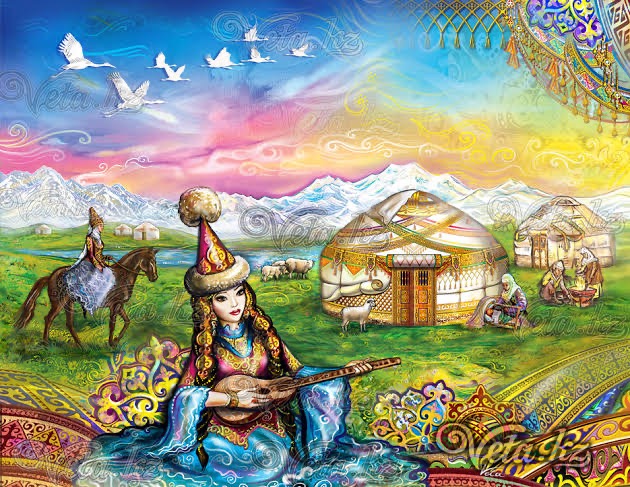
Introduction
In Kazakhstan, spiritual and cultural life is shaped by a long tradition of coexistence rather than strict separation. Many families, for example, celebrate the New Year (a Soviet legacy), pray for ata-baba (a shamanic practice), and observe Qurban Ait (an Islamic holiday) without seeing these practices as contradictory. They may recite dua and bata in the same social and emotional space (Askhat et al., 2020; Gabitov, 2016). What makes this tradition especially important today is that it is no longer expressed only in homes, rituals, or community gatherings. It is also increasingly performed through digital media, where short videos, photos, captions, music, and comment sections turn culture into something visible, shareable, and aesthetically framed for public audiences. This project examines how platforms such as TikTok, Instagram, Threads, and YouTube visually represent Kazakhstan’s blended spiritual traditions and how these representations shape ideas of belonging, continuity, and identity in the present. I will conduct a qualitative, cross-platform analysis of publicly accessible social media posts as multimodal media texts, reading images, captions, sound, and audience reactions alongside relevant scholarship on Kazakh spirituality and digital media methods.
In progress...